


Why Understanding Your Dog Is the Key to a Happier Life Together
Effective communication with our dogs is the foundation of a happy relationship and the solution to many of the challenges that can arise in everyday life.
THE ROOT OF THE PROBLEM
Communication lies at the heart of every healthy relationship. Whether among humans or animals, the exchange of information is constant and works best in an environment built on trust, clarity, and positive interaction.
Dogs, however, communicate in a way that is fundamentally different from humans. They do not use a language based on grammar, vocabulary, or complex verbal structures. Instead, they rely on a sophisticated system of signals that is remarkably effective when properly understood.
When a dog’s messages go unnoticed or are misinterpreted, problems often follow. The dog may appear disobedient, bark excessively, become anxious, or even display aggressive behavior. For this reason, every dog owner has a responsibility to observe, understand, and learn how their companion communicates. When challenges arise, seeking reliable information and professional guidance can make a significant difference.
THE HUMAN–DOG COMMUNICATION GAP
Like humans, every dog is an individual. Yet dogs also carry deeply rooted instincts shaped by thousands of years of evolution. Within a canine social group, certain rules and behaviors are naturally transmitted from one dog to another, beginning with the mother during the earliest stages of life.

When a dog enters a human household, it suddenly finds itself in a completely different environment. While most dogs do their best to adapt, the rules of family life are not always communicated in ways they can understand.
Learning to communicate with a dog is much like learning a foreign language. It is not especially difficult, but it requires understanding a few essential principles and applying them consistently. Otherwise, the dog receives mixed or contradictory signals that create confusion rather than clarity.

Modern life can make this even more challenging. Without realizing it, many people project their own stress, anxiety, and emotional tension onto their dogs—states that are not part of the animal’s natural way of being.
Breed characteristics also play an important role. Every breed was developed for specific purposes and possesses unique traits, instincts, and needs. Understanding those characteristics is essential for creating a balanced and rewarding relationship.
When communication breaks down, frustration can develop on both sides. Yet life with a dog should be a source of joy, companionship, learning, and mutual growth.
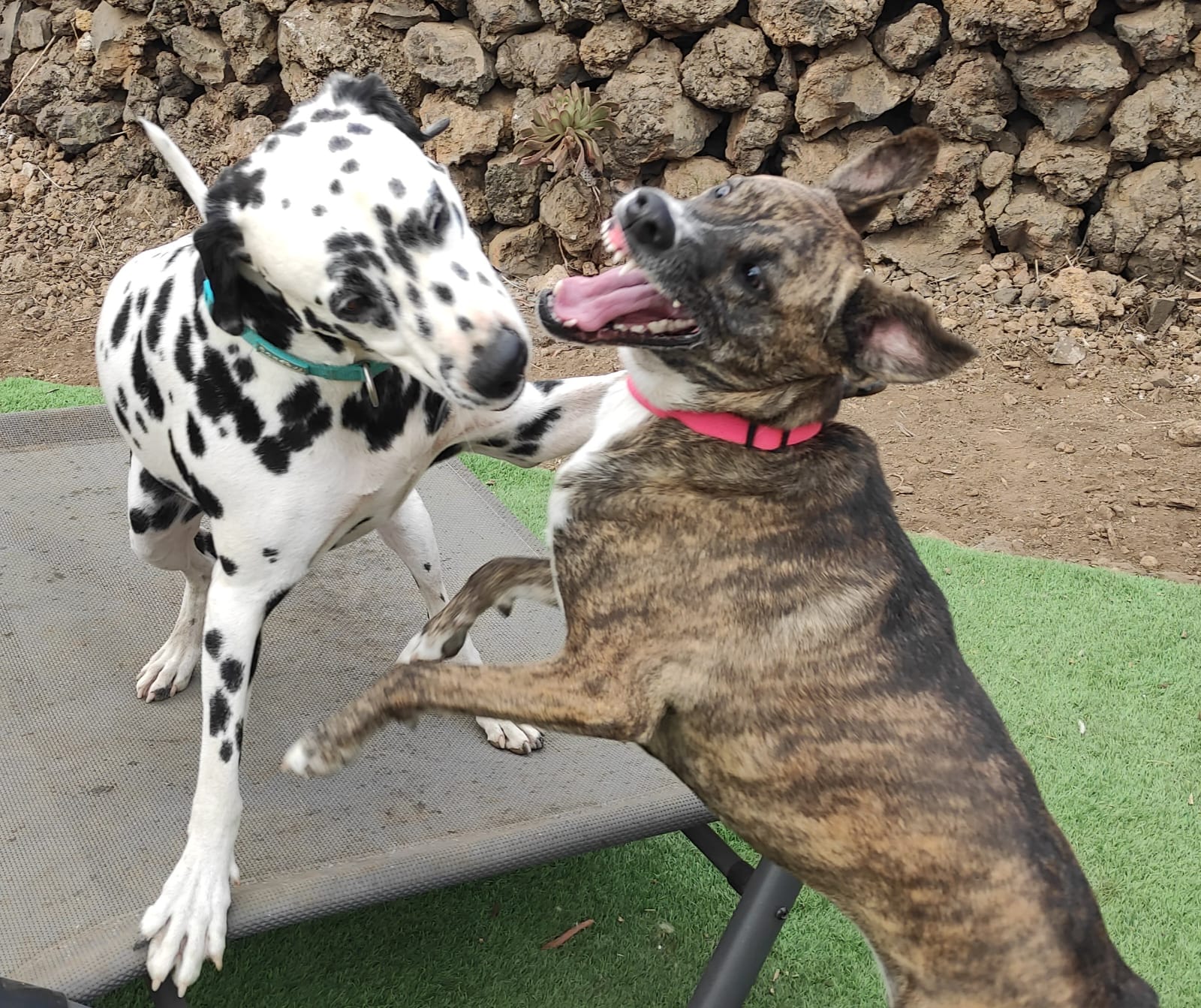
For this reason, opportunities for healthy play and socialization with other dogs are extremely important. In a safe and controlled environment, dogs learn from one another in much the same way they would in nature, developing appropriate social skills and emotional stability.
WHY DO DOGS UNDERSTAND COMMANDS IN LANGUAGES THEY HAVE NEVER HEARD?
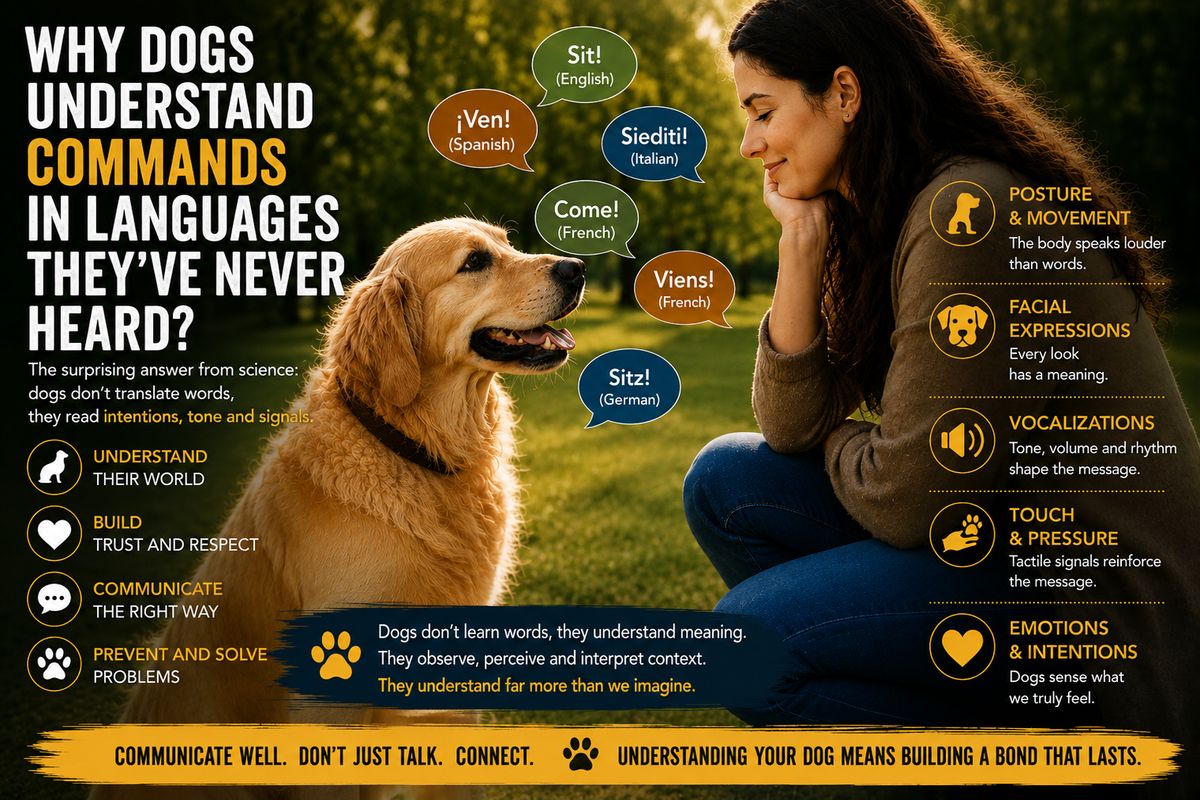
Most people assume that dogs learn verbal commands in a specific language.
Yet at Tenerife Dog Boarding and Training, where dogs from many different countries and language backgrounds interact every day, it is common to observe dogs responding correctly to commands spoken in languages they have never heard before.
How is that possible?
The answer is that dogs are extraordinary observers.
They interpret far more than words. They pay attention to body posture, facial expressions, tone of voice, movement, energy, and even subtle changes associated with a person’s emotional state.
Research on human communication has long shown that words represent only a small portion of the information exchanged between people. Much of communication occurs through nonverbal and paraverbal signals such as posture, facial expressions, and vocal tone.
Dogs are masters at reading these signals.
But there is something even more important.
The true secret of communication—both among humans and between humans and animals—is emotional connection.
Dogs are highly sensitive to the emotional state of their owners. When a strong bond exists, they often seem able to perceive intention before a word is even spoken.
This may explain why dogs can respond appropriately to commands delivered in unfamiliar languages. They are not simply reacting to vocabulary; they are responding to a combination of signals that includes intention, confidence, emotional state, and context.
For this reason, effective communication with a dog requires more than choosing the right words. It also requires adopting the right emotional state: calm, relaxed, confident, and quietly authoritative.
For many owners, this is the most challenging lesson of all because it often requires personal growth and greater self-awareness. Yet the benefits extend far beyond the relationship with the dog.
UNDERSTANDING CANINE LANGUAGE
Dogs communicate in countless ways.
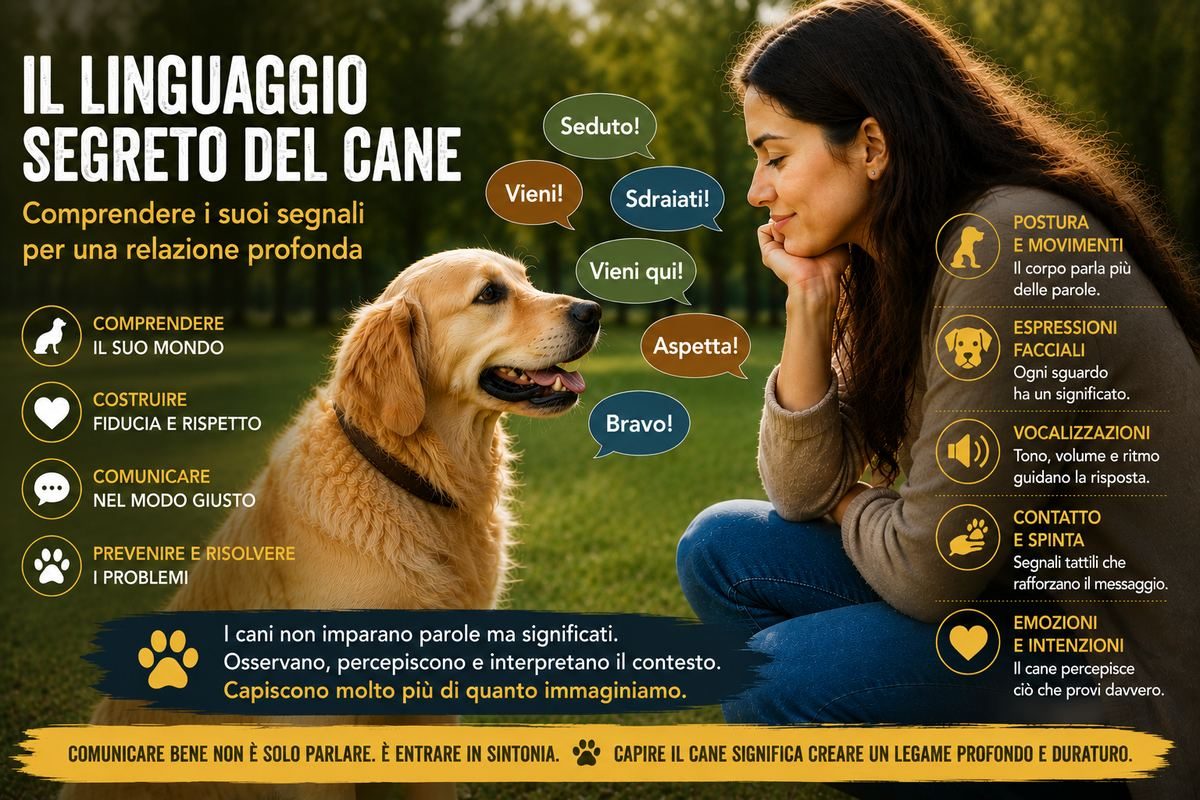
They use posture, body movements, tail position, facial expressions, vocalizations such as barking, growling, whining, and howling, as well as physical contact and many other subtle signals that often go unnoticed.

Before a dog bites, for example, it typically sends a series of warnings that are perfectly clear to other dogs but frequently overlooked by humans who have never learned to recognize them.
In reality, the individual who most often needs education in communication is not the dog—but the human.
As one well-known trainer famously said:
“A dog that doesn’t listen is often a dog that hasn’t been listened to.”
This article has only scratched the surface of a fascinating and complex subject. In future articles, we will explore these topics in greater depth to better understand the canine world and the extraordinary bond that connects dogs and humans.
Article produced in collaboration with Tenerife Dog Boarding and Training, offering dog boarding, daycare, training, dog walking, and related services.
